Alzheimer's research pioneer announces leadership transition after 38 years at Banner Health
Dr. Eric M. Reiman's groundbreaking work has transformed Alzheimer's research and positioned Banner as a global leader in detection and prevention studies
10/1/2026
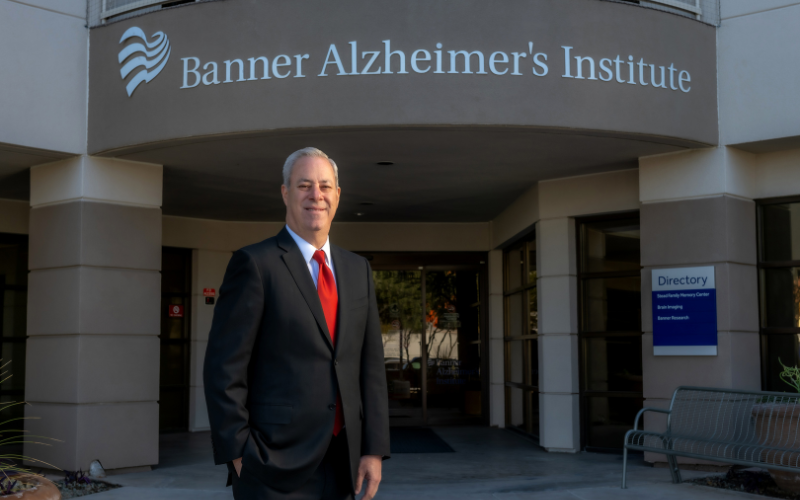
Banner Health has announced a leadership transition at Banner Alzheimer’s Institute, with Eric M. Reiman, MD, stepping down from his role effective Oct. 1 to embark on a new chapter in his professional and personal life.
Dr. Reiman plans to transition to independent roles that focus on Alzheimer's prevention and the emerging role of blood biomarkers and spend more time with his family. He will continue to provide his expertise as a Senior Advisor and collaborator at the Banner Alzheimer's and Banner Sun Health Research Institutes, participate in the Alzheimer's Prevention Initiative and Arizona Alzheimer's Consortium, and maintain his academic relationships with the University of Arizona, Arizona State University and the Translational Genomics Research Institute (TGen). He will also continue to serve as Board Chair of the Flinn Foundation.
Over his 38-year career, Dr. Reiman helped shape the global fight against Alzheimer's disease. Under his leadership as Founding CEO, Banner Alzheimer's Institute became an internationally recognized Center of Excellence, advancing prevention research and fostering landmark public-private partnerships that have brought the field closer than ever to the first approved Alzheimer's prevention therapies. "When BAI was founded in 2006, Eric and his colleagues set what many considered an audacious goal: to find and support approval of an effective Alzheimer's prevention therapy within a generation,” says Jerre Stead, Founding Chairman of the Banner Alzheimer's Foundation, the philanthropic arm supporting Banner Alzheimer’s Institute. “Twenty years later, we are living in a time of unprecedented hope. The prospect of preventing cognitive impairment before it begins is no longer a distant aspiration, but a realistic possibility.”
A legacy built on generosity: philanthropic support flourished under Dr. Reiman's vision
Among Dr. Reiman’s most enduring contributions is his extraordinary ability to inspire philanthropic investment in the fight against Alzheimer's disease — translating donor generosity into life-changing programs and expanded reach for Banner Alzheimer's Institute.
Under his leadership, BAI grew far beyond its Phoenix origins, with philanthropic support making possible the expansion of Banner Alzheimer's Institute to Tucson, bringing world-class Alzheimer's research, prevention, and care to Southern Arizona and extending the Institute's statewide impact in meaningful new ways.
Generous investment by the Edson family established the J. Orin Edson Family Lewy Body Dementia Center, one of the few dedicated centers in the nation focused on this devastating and often under-recognized disease. The Center has provided hope, specialized care, and a research home for patients and families navigating a diagnosis that too often goes unaddressed.
Philanthropic support has been equally transformative in expanding Family & Community Services programming at BAI — ensuring that patients and their caregivers receive not only expert medical care, but also the emotional support, education, and community connection that are essential to living well with dementia. The Dementia ECHO program, made possible through generous donor support, has extended that expertise far beyond BAI's walls, training clinicians across Arizona and beyond to deliver high-quality dementia care in their own communities.
Dr. Reiman also championed efforts to ensure that BAI's work reached those historically underserved by medical research. Native American Outreach initiatives, supported by philanthropic funding, have worked to build trust, increase access, and include Native American communities — who face a disproportionate burden of Alzheimer's disease — in the research and care that could one day prevent it. Perhaps most directly tied to the scientific frontier Dr. Reiman has long championed, the Fluid Biomarkers Program — supported by two generous families — has advanced the development and accessibility of blood-based tests that may one day allow Alzheimer's disease to be detected and treated before a single symptom appears. This program exemplifies the powerful intersection of philanthropy and science that has defined Dr. Reiman's tenure.
Taken together, these philanthropic achievements reflect not only the trust that donors have placed in Dr. Reiman's vision, but also the profound difference that generosity makes when guided by bold, purposeful leadership. The programs and centers built through that partnership between donors and Dr. Reiman will continue to serve patients, families, and the broader scientific community for generations to come.
"Mary Joy and I are deeply grateful for Eric's friendship and honored to have worked alongside him in building BAI,” says Stead, speaking on behalf of himself and his wife. “We are equally grateful that he will continue to help lead the fight against Alzheimer's in his new role and through his many ongoing scientific and academic endeavors. As we celebrate BAI's 20th anniversary, we also celebrate Eric's extraordinary contributions—and look forward with optimism to all that he and his colleagues will accomplish in the years ahead."
A career rooted in ending Alzheimer’s disease within our lifetimes
A psychiatrist and brain imaging researcher by training, Dr. Reiman is internationally recognized for pioneering contributions to brain imaging, genetics, multi-omics and blood biomarker research, including the presymptomatic detection of Alzheimer's biomarker changes in people at increased genetic risk. He has authored more than 800 publications and received numerous honors, including the Potamkin Prize, widely regarded as the highest international award in Alzheimer's research.
In 2006, Dr. Reiman and colleagues founded Banner Alzheimer's Institute around three bold goals: to find and support FDA approval of the first effective Alzheimer's prevention therapy within a generation, establish a new standard of care for patients and caregivers, and build new models of collaboration and resource sharing to have the greatest impact.
“One of Eric's most enduring legacies is what he built here in Arizona,” says Stead. “Through the Arizona Alzheimer's Consortium and his leadership of BAI, he helped create a model of statewide collaboration that brought together health care systems, universities, researchers, philanthropists, industry leaders, patients, and families in pursuit of a common mission. That collaborative spirit has established Arizona as one of the world's leading centers for Alzheimer's research and care."
In 2010, Dr. Reiman and his team established the Alzheimer's Prevention Initiative, which helped launch a new era in Alzheimer's prevention research. In 2012, they secured support for the first NIH-backed prevention drug trial, which was named a "World-Changing Idea" by Scientific American. This study and related efforts helped catalyze approximately 20 past, present and planned prevention trials globally, including other industry and NIH-supported trials.
"Dr. Reiman's contributions to Alzheimer's research have been nothing short of transformative," said Corey Casper, MD, senior vice president and chief research officer of Banner Health. "His ability to build coalitions, inspire collaboration and pursue bold ideas with scientific rigor has driven landmark breakthroughs and positioned Banner as a global leader in Alzheimer's prevention. We are deeply committed to building on the extraordinary foundation he has created and carrying this vital work forward."
In reflecting on his career and what lies ahead, Dr. Reiman says, "While there is no guarantee, the field now has a realistic chance to find and support access to the first effective 'secondary prevention therapy' in people with a positive Alzheimer's blood test sometime next year, better secondary prevention therapies to follow, and the first effective primary prevention therapy in those without detectable disease in roughly five years. I am extremely excited about the chance to help make that happen." Banner Health will conduct a national search for the next leader of Banner Alzheimer's Institute, and Dr. Casper will provide executive oversight in the interim. Separately, Jessica Langbaum, PhD, senior director of Alzheimer's prevention at Banner Alzheimer's Institute, will assume the Arizona Alzheimer's Consortium director role in October. Dr. Langbaum succeeded Dr. Reiman as director of the NIH-sponsored Arizona Alzheimer's Disease Research Center in 2024 and brings deep expertise and a strong continuity of vision to this work.